
How to identify and manage grubs and beetles in your lawn
West Seattle Nursery Staff
February 4, 2026
Last year we wrote about European chafer grubs and why crows, raccoons, and other critters were suddenly rolling back sections of lawn to feast on them. Since then, we’ve had a lot of great questions and some new developments. The short version: European chafer isn’t the only grub problem in our area, and a few newer beetle species are starting to show up alongside some long-established ones.
Let’s break down which grubs we’re dealing with, how to recognize damage, and what actually works to manage them, without wrecking the rest of your garden ecosystem.
Several Grub Species, One Lawn Problem
“White grub” isn’t a single insect. It’s a catch-all term for the larval stage of several different beetles that share similar habits. In our region, the most common culprits include:
European chafer beetles (recently established and spreading)
Ataenius beetles
Japanese beetles (newly detected populations in Des Moines)
June beetles / May–June beetles
Weevils, including black vine weevil and strawberry root weevil
Billbugs (which produce smaller grubs but similar damage)
Some of these species have been here for decades, and others are new arrivals. What they all have in common is: their larvae feed on grass roots, weakening turf and setting the stage for wildlife damage.
How to Identify White Grubs
Adult beetles vary widely in size, color, and shape, but the larvae look surprisingly similar across species:
1–2 inches long
White or cream-colored bodies
Brownish head capsule
Grayish rear end (called the raster)
Typically curled into a C-shape when unearthed
Entomologists use the pattern of hairs on the raster to identify species, but for most home gardeners, the exact ID matters less than knowing when and how to control them.
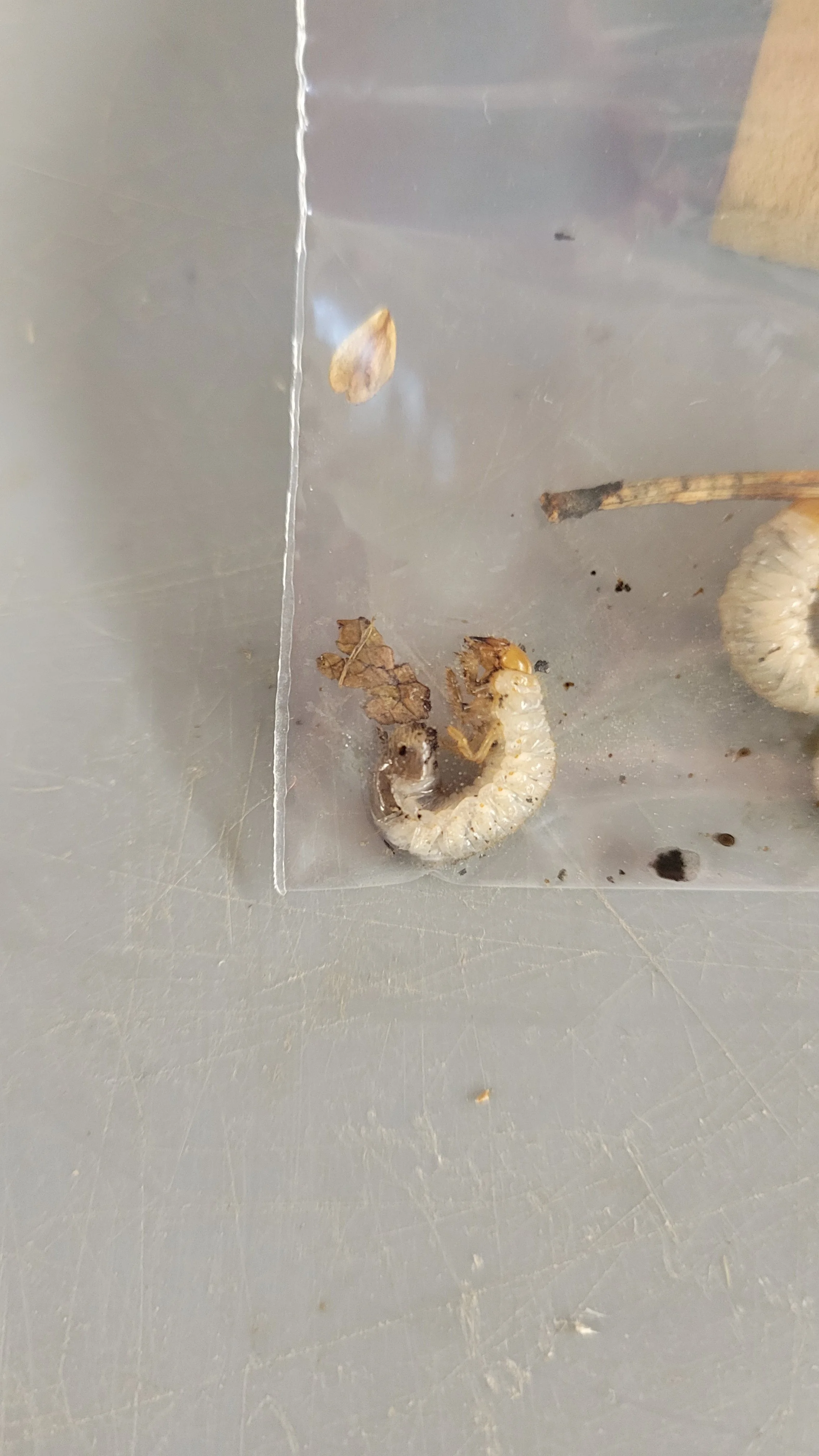
A grub brought in by a customer from their garden
Damage: What You See (and What You Don’t)
Spring & Summer
Grub damage often starts invisibly. As larvae chew through grass roots, turf may:
Wilt despite watering
Turn yellow or brown in irregular patches
Pull up easily like loose carpet
Fall & Winter
This is when many people first notice a problem, not because of the grubs themselves, but because of wildlife.
Crows, raccoons, skunks, and even moles dig aggressively to reach the protein-rich larvae. As we mentioned in our earlier European chafer article, the animals are a symptom, not the cause.
Adults vs. Grubs: Two Stages, Two Strategies
White grub management works best when you understand the beetle life cycle.
Adult Beetles (Late Spring-Summer)
Adults emerge anywhere from April through July, depending on species. They feed on the foliage and flowers of hundreds of trees, shrubs, and perennials, mate, and lay eggs.
Controls for adults include:
Azadirachtin (neem oil extracts): acts as a feeding deterrent and repellent
Spinosad: a soil-derived bacterial toxin effective at killing adults
Trapping: helpful for some species, though rarely sufficient on its own
Tip:
Avoid mowing lawns shorter than 3 inches. Closely cropped turf is far more attractive to egg-laying females. (Yes, ‘No Mow May’ really can help.)
Eggs & Young Larvae (June-August)
Mated females move into turf in late afternoon and lay eggs about 3 inches underground, where moisture is available. Eggs hatch in roughly two weeks.
Best controls at this stage:
Beneficial nematodes (beneficial microscopic roundworms)
Bacterial insecticides
Milky spore (only effective on Japanese beetle larvae)
Bacillus thuringiensis galleriae (Btg) for a broad range of grubs
This is the most effective window for reducing future damage. Multiple applications may be needed, especially with nematodes.
Large Grubs (September-October)
By early fall, larvae are big enough to cause serious turf damage, and to attract hungry wildlife.
Controls:
Bacterial insecticides
Beneficial nematodes (beneficial microscopic roundworms)
Winter Dormancy (December-March)
Grubs overwinter deeper in the soil and are mostly inactive.
Controls still possible:
Milky spore (Japanese beetles only)
Parasitic nematodes (with reduced effectiveness)
Spring Feeding & Pupation (March–June)
Grubs move back up to feed before pupating into adults.
Controls:
Bacterial insecticides to reduce survival into adulthood
A Note on Japanese Beetles & Milky Spore
Because Japanese beetles are newly established in nearby Des Moines, this is worth emphasizing:
Milky spore only works on Japanese beetle grubs. It has no effect on European chafer, Ataenius, or other species. That’s why correct identification or choosing broad-spectrum biological controls like Bacillus thuringiensis galleriae (Btg) matters.
Water Wisely: Irrigation Trade-Offs
Irrigation plays a surprisingly complex role in grub management:
Dry, dormant lawns during early summer are less attractive to egg-laying adults and reduce egg survival.
Well-watered lawns are more resilient and recover better if some root damage occurs.
There’s no single “right” answer—just a balance based on your lawn’s age, health, and tolerance for damage.
Let Nature Help (A Little)
Allowing small grub populations to persist can actually encourage natural diseases and predators that help regulate beetle numbers over time. Total eradication often backfires; long-term balance is the goal.
And, as we said in our earlier chafer article, one of the most effective solutions is also the simplest:
Replace some or all of your lawn with a pollinator garden.
Less turf means fewer grubs, less watering, fewer inputs, and far more ecological benefit.
The Takeaway
Multiple beetle species are affecting lawns, not just European chafer
Japanese beetles are new to the area and require species-specific management
Timing matters more than force when it comes to control
Biological tools like beneficial nematodes and bacterial insecticides are effective and environmentally responsible
If you’re unsure which grub you’re dealing with or when to treat, stop by the nursery. We’re always happy to help you figure out the best next step for your yard and the ecosystem around it.
Updated 2/9/26